Branding · 4 min read
How to Build a Brand That Customers Remember
Memorability is not budget. It's positioning, story, a visual system that repeats, and an experience that confirms the promise.
Covenant Label Designs — Brand Strategy & Creative Studio · Oct 12, 2026
Some brands are remembered. Most are processed and forgotten within seconds. The difference is rarely budget, and it is almost never the logo.
Memorability is a byproduct of repetition and distinctiveness applied to a clear idea. When one of those three is missing, the other two cannot compensate. Here is how the components fit together.
Positioning: pick a lane you can own
Memory needs a hook. "We're a full-service agency that does everything for everyone" gives the brain nothing to file. Contrast that with a business known specifically for one thing — the fastest turnaround, the most technical product, the calmest client experience, the most distinctive visual style.
Ownable positioning usually comes from an honest assessment of three inputs: what you are genuinely good at, what the market is underserved on, and what competitors cannot easily copy. The intersection is small. That is the point.
A useful test: finish the sentence "For [specific audience], we are the ones who [specific difference], because [credible reason]." If the sentence could be used by any three competitors, keep working.
Storytelling: give the facts a shape
People retain stories far more reliably than feature lists, and the story does not need to be dramatic. It needs to be concrete and specific.
The most useful brand stories follow a simple arc: a real problem your customers recognize, the tension of living with it, the decision to solve it differently, and what changed as a result. Your founding story is one version of this. Your customer stories are usually stronger, because the protagonist is the audience.
Specificity is what makes it stick. "We help businesses grow" evaporates. "We rebuilt a 40-year-old family bakery's ordering system so their Saturday line moved twice as fast" is retrievable a week later.
Visual identity: a system that repeats
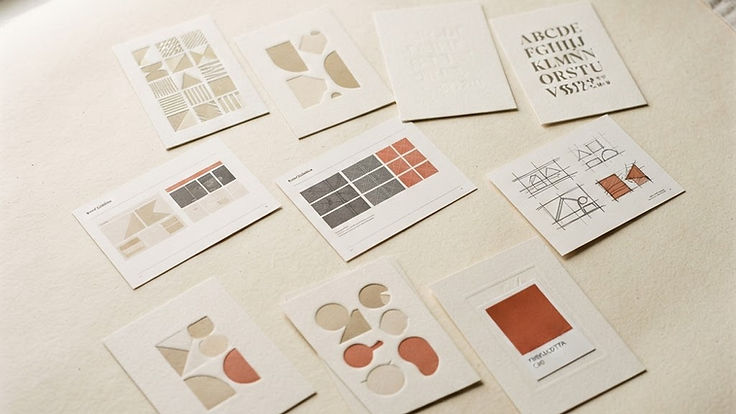
Distinctiveness at scale comes from consistent, repeated decisions: a typographic voice, a color used with discipline, a photographic treatment, a layout instinct. Recognition is pattern recognition — you are giving the audience a pattern to learn.
Three practical requirements:
- Distinctive, not merely attractive. Attractive is table stakes in a design-saturated market. Ask whether someone could identify your marketing with the logo removed.
- Repeatable by non-designers. If only one person can execute it, it will decay. Templates, rules, and clear constraints matter more than a beautiful one-off campaign.
- Durable enough to outlive a trend. Trend-chasing dates a brand quickly. Borrow trend energy in campaigns, keep identity decisions on a longer horizon.
Messaging: say one thing often
Businesses get bored of their own message long before the market hears it. The instinct to add new claims every quarter is the enemy of memorability — it resets the audience's learning every time.
Choose a primary promise, a handful of supporting proofs, and an objection-handling set. Then repeat them with variations in evidence, not in substance. The message should feel repetitive internally and fresh externally. That gap is normal.
Write it down in a messaging framework so the sales team, the website, and the social calendar are all saying the same thing in different registers.
Differentiation: the thing you can't copy by Friday
Real differentiation is rarely visual. It is structural: a process, a guarantee, a specialization, a point of view, a service model, a piece of technology, a community.
Decide what your unfair advantage is, then point the brand at it. If your differentiator is speed, every visual cue, testimonial, and page should feel fast. If it is craft, the brand must tolerate slowness and detail — and the website had better take three seconds to load, not nine.
Alignment between differentiator and expression is where memorability compounds.
Customer experience: where trust is actually earned
Brand is a promise; experience is the verification. Every inconsistency between the two costs more than a stronger claim can recover.
The touchpoints that matter most are boring: how quickly you reply, whether the invoice is clear, whether onboarding matches what the sales call implied, whether the product works the first time. Excellence in these areas is what turns a recognized brand into a trusted one.
Measure it. Ask new customers what they expected, then compare that to what they got.
The practical order of work
- Decide the one thing you want to be known for (positioning).
- Build a credible reason you can be (differentiation).
- Shape it into language people repeat (story and messaging).
- Create a repeatable visual system (identity).
- Deliver it consistently in every interaction (experience).
- Repeat for years (patience).
None of it is glamorous, and all of it works. The brands people remember did not get there through a single brilliant campaign. They got there by being clear, distinct, and relentlessly consistent until the market stopped needing to be reminded.
Key takeaways
- Memorability comes from repetition and distinctiveness applied to one clear idea.
- Differentiation is usually structural — a process, guarantee, or point of view, not a visual style.
- Brand is the promise; customer experience is where that promise gets verified.