Branding · 4 min read
Your Logo Is Not Your Brand: Here's What Actually Builds Brand Identity
A logo is a signature, not a story. The five layers that actually build a brand — and how to tell which one your business is missing.
Covenant Label Designs — Brand Strategy & Creative Studio · Oct 24, 2026

Almost every conversation about branding starts in the same place: the logo. Someone wants "a new logo," and the assumption underneath the request is that the logo is the brand. It is a reasonable assumption, because the logo is the most visible thing a business owns. It is also the reason so many rebrands fail.
A logo is a signature. A brand is the meaning that signature points to. Swap the signature without changing the meaning and customers notice the letterhead changed, not the company.
What a brand actually is
A brand is the sum of what people believe about you, formed from every interaction they have with your business — the website, the invoice, the way the phone gets answered, the review they read at 11pm.
In practice, a brand is built in five layers. When those layers are coherent, the logo does very little work. When they are incoherent, no logo can rescue them.
1. Positioning
Positioning is the decision about where you compete and why anyone should choose you over the alternative. It precedes design, because design has to express a decided idea, not decorate an undecided one.
A weak positioning statement sounds like: "We provide high-quality products and exceptional customer service." A strong one makes a trade-off: who you are not for, what you will not do, and what you are the obvious choice for.
2. Perception
Perception is what actually lives in the market — and it is not a debate. If customers describe you as "the affordable option" while you describe yourself as premium, the perception is the reality you are working from. Brand strategy starts by measuring the gap between intended meaning and received meaning, then closing it.
3. Visual identity
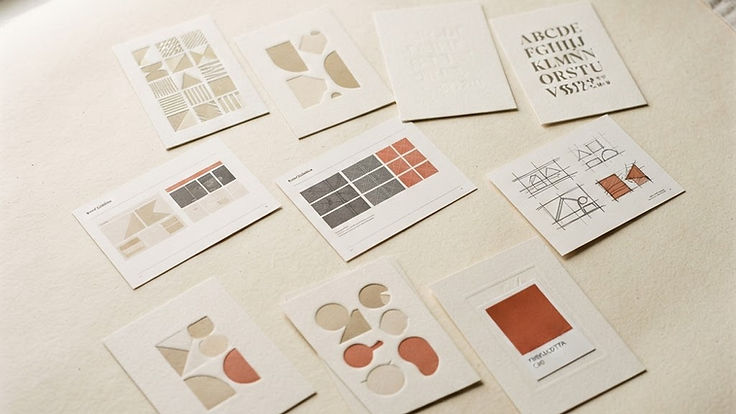
This is where the logo lives, alongside a type system, color palette, photography direction, layout rules, and iconography. Identity is a system, not an asset. One mark on its own says almost nothing; a consistent system across a site, a deck, a sign, a shirt, and a proposal says "this is a serious operation" without a single sentence.
4. Voice and messaging
Voice is how you sound when nobody is scripting you. Messaging is what you say, in what order, to whom. Most businesses have messaging by accident — three different descriptions of the same company across the homepage, the sales call, and the LinkedIn bio. Unifying that is usually the highest-return branding work available, and it costs nothing to start.
5. Experience
Every touchpoint either confirms or contradicts the promise. A premium brand with slow email replies and a broken mobile checkout is teaching customers not to believe its marketing. Experience is where brand claims are audited by reality.
What a logo can and cannot do
A good logo does four quiet jobs: it is recognizable at small sizes, it works in one color, it reproduces across embroidery, print, and screen, and it looks like it belongs to your category without disappearing into it.
What it cannot do is manufacture trust, imply a strategy, or create differentiation that does not exist elsewhere in the business. When a company with unresolved positioning invests in a new logo, the market response is neutral. Not hostile, just indifferent — which is worse, because it feels like proof that branding does not work.
How to diagnose which layer you actually need
Ask three questions:
- Can three people in your company describe what you do and who it is for, the same way? If not, the problem is positioning, not design.
- Does your website look like the caliber of work you actually deliver? If it undersells you, that is identity.
- Do customers describe you the way you describe yourself? If not, that is messaging and experience.
Most requests for a new logo turn out to be a request for clarity in one of those three areas.
Where to start
Start with the sentence you want people to repeat about you when you leave the room. Write it down. Test it on five customers and three prospects. Then build the identity system around it — the type, the color, the imagery, the voice — and finally, let the mark condense the whole thing into a shape.
That sequence is slower at the start and dramatically faster later. It also means the logo you end up with is defensible in a board meeting rather than merely liked in a presentation.
The businesses that feel inevitable from the outside almost always did this work in this order.
Key takeaways
- A logo is a signature; a brand is the meaning it points to.
- Positioning, perception, visual identity, voice, and experience are the five layers that build a brand.
- Most requests for a new logo are really requests for clarity in positioning, messaging, or experience.